


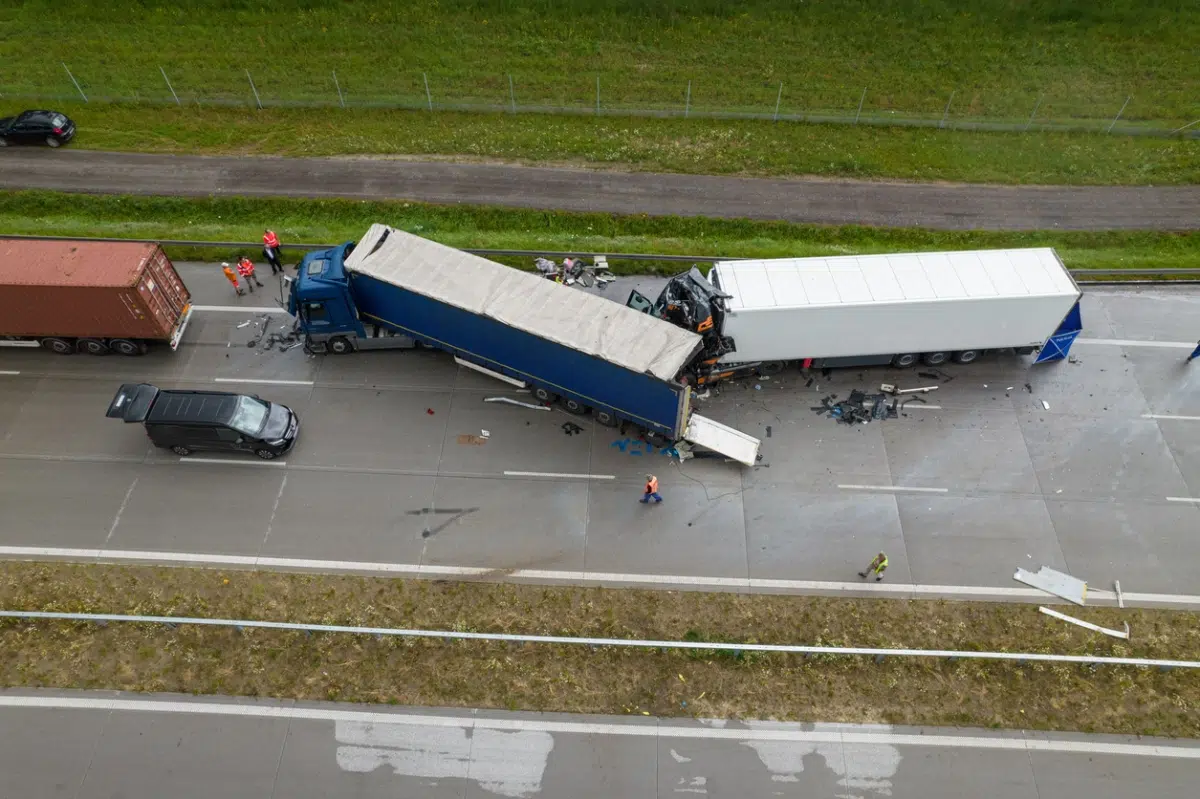


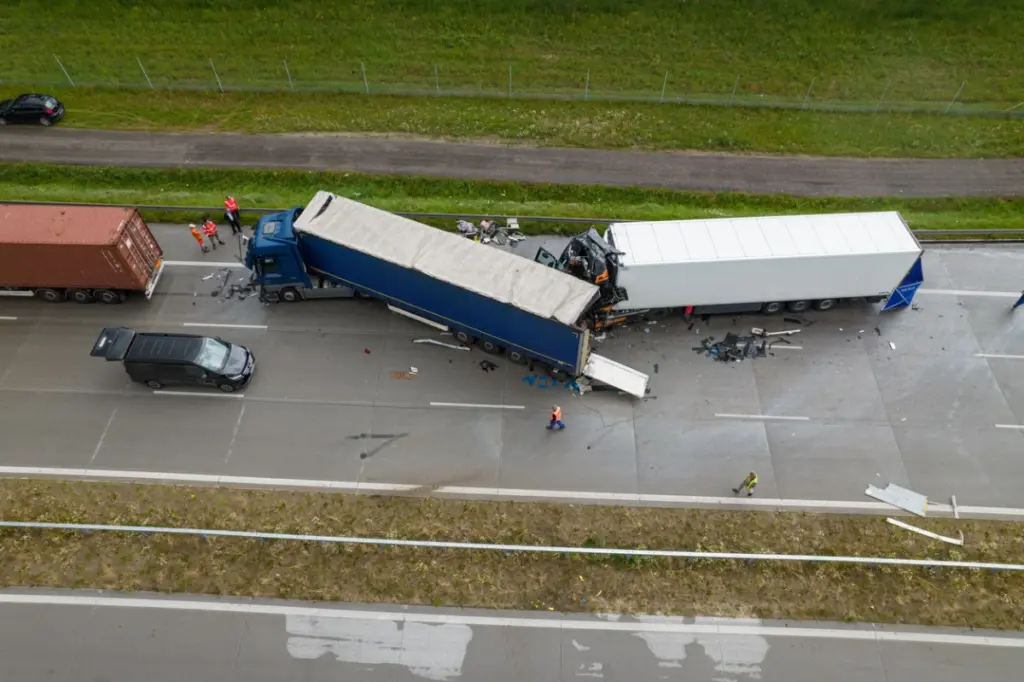
If you’ve been hurt in a collision with an 18-wheeler, you’re likely dealing with mounting medical bills, lost income, and serious uncertainty about what comes next. The good news is that you almost certainly have legal options. This guide walks you through who you can sue, what compensation is available, how the legal process works, and what steps to take right now to protect your claim.
Key Takeaways
- Yes, you can usually sue after an 18-wheeler accident. If another party’s negligence caused the crash, you can file truck accident claims through insurance or pursue a formal truck accident lawsuit in civil court.
- Multiple parties may be liable. Truck accident cases often involve multiple parties, including the truck driver, the trucking company, cargo loaders, maintenance providers, and truck manufacturers.
- These cases are more complex than car crashes. Commercial truck accidents are governed by federal trucking regulations, involve higher insurance policies, and require specialized investigations into driver logs and maintenance records.
- Strict deadlines apply. Statutes of limitations for filing truck accident lawsuits vary by state, but most require you to file within two years of the accident date. Missing that window can eliminate your right to sue entirely.
- Settlements tend to be higher than car accident claims. There is no single average truck accident settlement, but the combination of severe injuries, larger policy minimums, and regulatory violations means truck accident settlement amounts often far exceed those from typical car crashes.
Can You Sue After an 18 Wheeler or Semi Truck Accident?
Most victims of an 18-wheeler or semi truck accident can sue or bring claims if someone else’s fault caused the crash. Negligence is the most common ground for a lawsuit in truck accidents, and it can stem from many different sources.
You may have the right to sue when the crash was caused by:
- A truck driver who was speeding, fatigued, distracted, or impaired
- A trucking company that pressured unsafe schedules or failed to maintain vehicles
- A cargo loader or shipper responsible for improperly secured cargo
- A maintenance contractor that performed negligent repairs
- A vehicle or parts manufacturer that produced a defective truck component
You can pursue both an insurance claim against the carrier’s insurer and, if the offer is inadequate or liability is disputed, a formal truck accident lawsuit in civil court to seek fair compensation. Lawsuits are available for serious injuries like fractures, spinal cord damage, and traumatic brain injury, as well as for wrongful death when a loved one is killed.
To succeed, you’ll need to prove fault, document your losses (medical expenses, lost wages, pain and suffering), and follow the legal process in the state where the accident occurred.
Why 18 Wheeler and Truck Accident Cases Are More Complex
A semi truck accident or commercial vehicle accident is significantly more complicated than a standard car crash. The sheer size of commercial motor vehicles, the web of federal regulations that apply, and the number of parties involved all add layers of complexity.
Here’s what makes truck accident cases different:
- Multiple insurance policies. The truck driver, trucking company, trailer owner, and cargo owner may each carry separate insurance coverage. Federal law requires a minimum liability coverage of $750,000 for commercial trucks, and policies often go much higher.
- Federal and industry regulations. Semi trucks are governed by Federal Motor Carrier Safety Administration (FMCSA) rules that impose higher standards for inspections, driver qualifications, and hours of service than anything required for passenger cars.
- Dispatch and scheduling pressures. Commercial vehicle operators face company policies and dispatch pressures that can contribute to driver fatigue and unsafe driving decisions.
- Trucking accident claims often involve complex liability issues with multiple potential defendants. Sorting out which entity is responsible-owner-operator, leasing company, motor carrier, broker-requires experienced legal analysis.
These complexities are a key reason to involve a law firm with experience in commercial trucking litigation rather than trying to handle the claim on your own.
Key Federal Regulations That Affect Your Truck Accident Case
Commercial trucking is regulated by the Federal Motor Carrier Safety Administration under Title 49 of the Code of Federal Regulations, Parts 300–399. These Federal Motor Carrier Safety Regulations govern virtually every aspect of interstate trucking, and violations are frequently central to truck accident lawsuits.
Key regulations that matter in litigation include:
| Regulation Area | What It Covers |
|---|---|
| Hours of Service (Part 395) | Limits on driving hours per shift, mandatory rest breaks, weekly on-duty caps |
| Driver Qualification (Part 391) | Licensing, physical standards, experience, and clean driving records |
| Drug & Alcohol Testing (Part 382) | Mandatory post-crash testing, random screening, chain of custody |
| Vehicle Maintenance (Part 396) | Daily and periodic inspections, defect logging, repair records |
| Cargo Securement (Part 393) | Load balance, weight limits, tie-down requirements |
| CDL & Training (Parts 380, 383) | Entry-level driver training, commercial licensing standards |
Truck drivers must follow federal safety regulations, and showing a violation can support a legal theory called negligence per se-where breaking a regulation automatically establishes a breach of duty. Violations of hours-of-service regulations can serve as evidence in negligence claims, making it easier to prove fault.
Electronic logging devices and onboard “black box” engine control modules capture hours, speed, and braking data. For example, if a driver exceeded the 11-hour driving limit and then caused a tractor-trailer collision because of fatigue, that violation becomes powerful evidence in a truck accident claim.
Why Collisions with 18 Wheelers Cause Such Serious Injuries
A fully loaded commercial truck can weigh 80,000 pounds or more-roughly 20 to 25 times the weight of an average passenger vehicle. That mass difference makes the physics of these crashes devastating.
Common crash dynamics that produce serious or fatal injuries include:
- Underride collisions, where a car slides beneath the trailer
- Jackknife accidents, where the trailer swings outward
- Wide right turns that trap smaller vehicles
- Blind-spot side swipes and high-speed rear-end impacts
- Rollovers caused by shifting or overloaded cargo
Typical truck accident injuries include traumatic brain injury, spinal cord and nerve damage, herniated discs, compound fractures, amputations, burns from fuel fires, internal organ injuries, and PTSD. In 2019, large trucks caused approximately 510,000 accidents in the U.S., with thousands of fatalities and hundreds of thousands of injuries.
These severe injuries often require extended hospital stays, multiple surgeries, and long-term rehabilitation, sometimes resulting in permanent loss of earning capacity. The severity of truck accident injuries is exactly why accepting a quick, low settlement offer without consulting an experienced attorney is risky.
Who Can You Sue After an 18 Wheeler Accident?
Identifying every potentially liable party is essential to maximizing recovery. Truck accident lawsuits frequently involve multiple parties, and overlooking one defendant can mean leaving significant compensation on the table. Multiple parties can be liable in truck accidents.
Main categories of defendants include:
- The truck driver
- The trucking company or motor carrier
- The owner of the tractor or trailer
- Freight brokers, cargo loaders, or shippers
- Maintenance and repair shops
- Truck manufacturers and parts suppliers
- Other motorists who contributed to the crash
Ownership and lease arrangements in the trucking industry can be complicated. One company may own the truck, another owns the trailer, and a third employs the driver. Under doctrines like respondeat superior, trucking companies may be liable under vicarious liability for their drivers’ actions within the scope of employment.
Suing the Truck Driver and Trucking Company
Most truck accident cases start with claims against the driver and their employer. Negligence by truck drivers is a common basis for liability in truck accident lawsuits.
Common driver negligence allegations include:
- Speeding or aggressive driving
- Distracted driving and driving under the influence
- Driver fatigue from exceeding hours-of-service limits
- Following too closely or unsafe lane changes
A trucking company can face direct liability too. Trucking companies can be sued for negligent hiring and supervision, as well as for scheduling pressures that push drivers past safe limits. Company maintenance practices and failure to remove unsafe vehicles from service are also frequent issues in commercial vehicle accident claims.
Internal company documents, safety records, truck driver logs, and dispatch logs are important discovery targets in any truck accident lawsuit.
Other Potentially Liable Third Parties
Beyond the driver and carrier, several other parties may share blame:
- Cargo loaders and shippers. Cargo loaders can also be held liable for truck accidents. Improper cargo loading can result in liability for the loading entity or third party, especially when overloading or unbalanced loads cause rollovers or loss of control.
- Maintenance providers. Repair shops that performed negligent work-missing brake defects, failing to replace worn tires-can bear responsibility for improper maintenance that contributed to the crash.
- Vehicle and parts manufacturers. Claims can be filed against manufacturers for strict product liability if defective components like brakes, steering, or tires cause accidents. A defective truck component triggers a different legal theory than negligence.
- Other drivers. If another motorist cut off the truck or made a sudden stop, fault can be allocated among all negligent parties depending on state law.
What Compensation Can You Seek in a Truck Accident Case?
Damages in 18-wheeler accident lawsuits fall into three categories: economic, non-economic, and punitive. Victims can seek compensation for both economic and non-economic damages in truck accidents. Compensation claims can include pain and suffering and rehabilitation costs.
Economic and Non-Economic Damages
Economic damages cover measurable monetary losses like medical expenses. They are supported by hospital bills, pharmacy receipts, repair estimates, tax returns, and employer wage statements.
Common economic damages include:
- Past and future medical bills, including surgeries and rehabilitation
- Lost wages during recovery and loss of future earning capacity
- Home health care and assistive devices
- Property damage, vehicle damage, and vehicle repairs
Non-economic damages include pain and suffering and emotional distress. They also encompass PTSD, loss of enjoyment of life, disfigurement, and loss of consortium for a spouse or family member. These are more subjective; their value depends on the severity, visibility, and permanence of injuries.
To illustrate the range: a minor soft-tissue truck crash might settle for $18,000–$80,000, while a catastrophic injury case involving traumatic brain injury or paralysis can reach well into the millions. A truck accident attorney will compile a detailed damages summary before entering settlement negotiations.
Punitive damages may be awarded for particularly reckless conduct, such as drunk driving, falsified truck driver logs, or willful safety violations by the trucking company.
Wrongful Death in 18 Wheeler Accidents
Many semi truck crashes result in fatal injuries. When a loved one is killed, surviving family members may pursue a wrongful death lawsuit. Wrongful death damages in truck accidents are often significantly higher than personal injury claims.
Typically, a personal representative or executor of the estate files the wrongful death action on behalf of close family members. Recoverable compensation includes:
- Medical bills and expenses incurred before death
- Funeral and burial expenses
- Loss of financial support and benefits
- Loss of household services
- Loss of companionship, guidance, and consortium
Specific time limits and procedural rules for wrongful death truck accident claims differ from personal injury claims and vary by state. If you’ve lost a family member, speaking with a personal injury attorney promptly is essential.
How Much Is the Average Settlement for an 18 Wheeler Accident?
There is no universal average settlement, but truck accident settlements consistently exceed those from car accidents. The average truck accident settlement amount is $103,654.08 according to available claims data, though this figure blends minor and severe cases together.
Settlement ranges vary dramatically based on circumstances:
| Injury Severity | Typical Range |
|---|---|
| Minor (soft tissue) | $18,000 – $80,000 |
| Moderate (surgery required) | $80,000 – $240,000 |
| Severe / Catastrophic | $250,000 – $2,000,000+ |
Settlement amounts depend on injury severity and medical expenses, as well as:
- Length of recovery and permanence of disability
- Amount of lost income and future earning capacity
- Available insurance coverage and policy limits
- Strength of liability evidence, including federal regulation violations
- Whether comparative negligence reduces the plaintiff’s recovery
Federal law requires minimum liability coverage of $750,000 for trucks, which creates a higher floor for recoveries compared to standard auto policies. For hazardous materials carriers, minimums can reach $1–5 million. An experienced truck accident attorney or law firm will review your medical records, wage information, and liability evidence to estimate a fair settlement range before entering negotiations.
What to Do Immediately After an 18 Wheeler Accident
Your health and safety come first. In the hours and days following a semi truck accident, the steps you take can significantly affect both your recovery and your legal claim.
At the accident scene:
- Move to a safe location away from traffic if you can do so without worsening injuries.
- Call 911 immediately. Report the accident to the police immediately-the official crash report is critical evidence.
- Check yourself and others for serious injuries. Accept emergency medical treatment without delay.
- Document the accident scene with photos and notes: capture vehicle positions, skid marks, road conditions, weather, company markings on the semi truck, the USDOT number, and visible damage.
- Gather witness information for your case-names, phone numbers, and brief descriptions of what they saw.
- Exchange information with the truck driver, including their employer, insurance details, and CDL number.
In the days after:
- Follow all medical advice and attend every follow-up appointment. Gaps in medical treatment can undermine your damages claim.
- Do not give recorded statements or sign documents from insurance companies without legal counsel.
- Contact a truck accident attorney for legal guidance as soon as possible after receiving initial care.
How the Legal Process Works in an 18 Wheeler Accident Case
The legal process in a truck accident case generally follows a predictable roadmap, though timelines vary. Truck accident claims often settle within 6 to 16 months post-accident, but complex cases involving severe injuries can take longer.
Major stages include:
- Investigation and evidence preservation – Your legal team secures black box data, driver logs, inspection records, and dispatch files.
- Insurance notification and claims – Demand packages are sent to the responsible parties’ insurers.
- Settlement negotiations – Adjusters review evidence; your attorney negotiates for fair compensation.
- Lawsuit filing – If negotiations stall, a truck accident lawsuit is filed in civil court.
- Discovery, depositions, and expert reports – Both sides exchange evidence and take sworn testimony.
- Mediation or trial – Many cases settle during mediation. If not, a jury trial determines the outcome.
Preparation as if going to trial tends to produce better settlement offers. Experienced truck accident attorneys understand this dynamic and build cases accordingly.
Critical Evidence in a Truck Accident Case
Early evidence preservation is vital in trucking accident cases to prevent loss of critical information. Trucking companies control most of the key records, and electronic data can be overwritten quickly.
Evidence such as driver logbooks and electronic logging device records is critical in trucking cases. Other important evidence includes:
- ELD and black box data (speed, braking, hours)
- Pre- and post-trip inspection reports
- Maintenance and repair records
- Dispatch and trip sheets
- Company safety manuals and training records
- Police reports and accident reports
- Scene photographs, dashcam video, and traffic camera footage
- Eyewitness statements
Expert accident reconstructionists may analyze vehicle damage, skid marks, and digital data to explain how the truck crash occurred. A truck accident attorney will typically send preservation letters (also called spoliation letters) to the trucking company and other responsible parties to prevent destruction of these records.
Deadlines and Statutes of Limitations
Every state has a statute of limitations setting a strict deadline to file a personal injury lawsuit. For most truck accident claims, this deadline is two years from the date the accident occurred, though some states allow three years.
Important nuances:
- Wrongful death claims may have different deadlines than personal injury claims.
- Claims against government entities often have much shorter notice requirements (sometimes 30–180 days).
- Missing the statute of limitations usually means losing the right to sue, regardless of how strong the case is.
Evidence also deteriorates over time-witnesses forget details, surveillance footage is deleted, and electronic records are overwritten. Earlier legal action generally strengthens a truck accident claim.
How a Truck Accident Attorney Can Help You
Commercial vehicle accident claims are resource-intensive. Insurance companies employ teams of adjusters, investigators, and defense attorneys. An experienced truck accident attorney levels the playing field.
What experienced truck accident attorneys typically handle:
- Investigating the crash and preserving time-sensitive evidence
- Identifying all potentially liable parties, including multiple potentially liable parties you might not have considered
- Calculating full damages including future medical bills and lost income
- Managing communications with insurance adjusters
- Protecting you from harmful recorded statements or premature releases
- Negotiating a fair settlement or taking the case to trial
Most truck accident law firms work on a contingency fee basis, meaning you pay no upfront fees and only owe legal fees if the attorney helps you recover compensation. A personal injury lawyer experienced in cases involving commercial trucking companies and federal safety regulations can make a significant difference in the financial compensation you ultimately receive.
If you or someone you care about has been injured in a tractor-trailer collision, reach out to a qualified personal injury attorney for a free consultation to discuss your specific case and legal options.
Frequently Asked Questions
- Do I have to sue, or can I just file an insurance claim after a truck accident?
Most truck accident cases start as insurance claims, and many resolve through settlement without a formal lawsuit ever being filed. However, you may need to sue if the insurer denies liability, disputes the extent of your injuries, or refuses to offer a fair settlement amount. Your truck accident attorney will typically try to negotiate first but will file suit if necessary to protect your rights before the statute of limitations expires. Even after a lawsuit is filed, cases can still settle at any time before or during trial.
- How long does an 18 wheeler accident case usually take?
Timelines vary widely. Truck accident claims can take 6 to 16 months to settle in straightforward situations, while complex or catastrophic injury cases may take well over a year. The length of medical treatment, need for expert reports, and court schedules all influence the timeline. Waiting until your medical condition is reasonably stable helps ensure any settlement reflects your long-term needs.
- What if I was partly at fault for the truck accident?
The impact of partial fault depends on your state’s negligence rules. In most states using comparative negligence, you can still recover financial compensation as long as your share of fault is below a certain threshold, but your award will be reduced by your percentage of responsibility. In a few contributory negligence states, any fault on your part may bar recovery entirely. Don’t assume you have no case-speak with a truck accident attorney before accepting an insurer’s assessment of fault.
- Should I talk to the trucking company’s insurance adjuster?
Be cautious. Adjusters may seek recorded statements, broad medical authorizations, or push quick settlements that don’t account for future medical costs or lost income. It’s best to speak with a personal injury lawyer before giving detailed statements or signing any documents. Once you’re represented, your attorney handles all communications with insurers to avoid misstatements or unfair tactics.
- How soon after a truck accident should I contact a lawyer?
Contact a truck accident attorney as soon as possible after receiving initial medical care. Early involvement allows the lawyer to secure black box data, truck driver logs, and other time-sensitive evidence before it is lost or overwritten. Prompt legal help prevents missed deadlines and reduces the risk of inadvertently harming your case. Most truck accident law firms affiliated with organizations like the National Trial Lawyers offer free initial consultations, so there is little downside to getting legal advice early.